
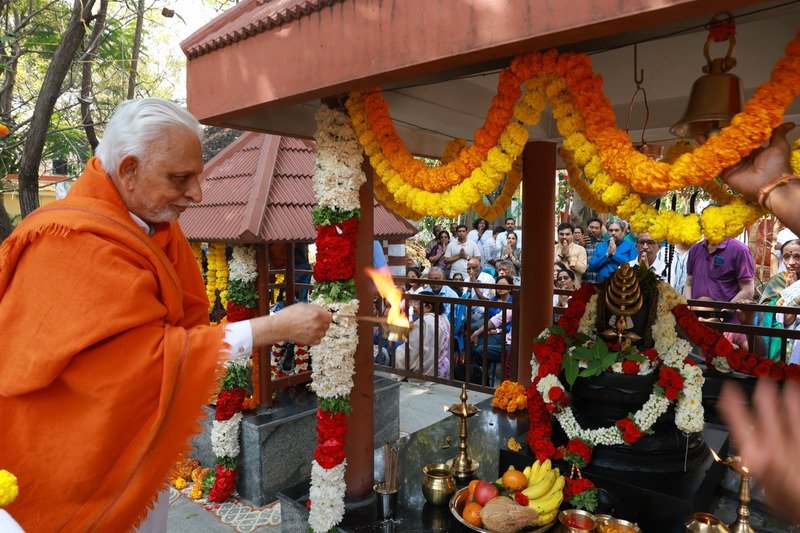
Shivam is actually within you always, but you don’t realise it.
So, to realise that, understand that you carry your Shiva wherever you go, within you.
In North Karnataka, in the Bagalkot region, there was a great reformer Basaveshwara, also known as Basavanna, who taught that everyone should carry their own linga, hence the name Lingayats. He began the practice of giving a small linga, made from herbs, medicines, and resins, consecrated and given especially to elders so they could keep it with them. In earlier times, it was placed in a small box and worn on a thread. His simple message was: your Shiva is always with you.
In those days, when we were so caste-bound, a person who was not supposed to enter the Shiva temple entered the Shiva temple. That was a big problem. They had to do eighteen days of washing the temple and had to feed hundreds of people to make sure that the Shiva linga in the temple was not polluted.
So Basava sang, (I don’t know the exact Kannada words) “Shiva, my dear Shiva, I thought that by your one touch and by your one look, the whole world is purified. How is it that your temple has become impure because one poor fellow entered the temple?”
And therefore, he said, ‘if they do not allow you, then have your own Shiva. Worship your own Shiva’ and he gave them all small Shiva lingas.
But we are going one step further and saying something deeper – there is no time when Shiva is not with us.
Deep in the recesses of our mind, in our consciousness, the true reality that sits there is Shiva. You should remember this always.
Meditation on the Linga
When you meditate, fix your attention either in the Bhrumadhya or in the Hridaya, and meditate on the linga, which is a symbol of Shiva.
Linga is the symbol of the true Shivam, who sits in our heart, inside – the sanctum sanctorum within you. And when you chant, when you sing, it shines.
The Temple and the Inner Presence
The same is true of Sri Guru Babaji. We have a temple here, and it is a beautiful thing. You can go and enjoy it, especially since there are very few temples dedicated to Sri Guru Babaji.
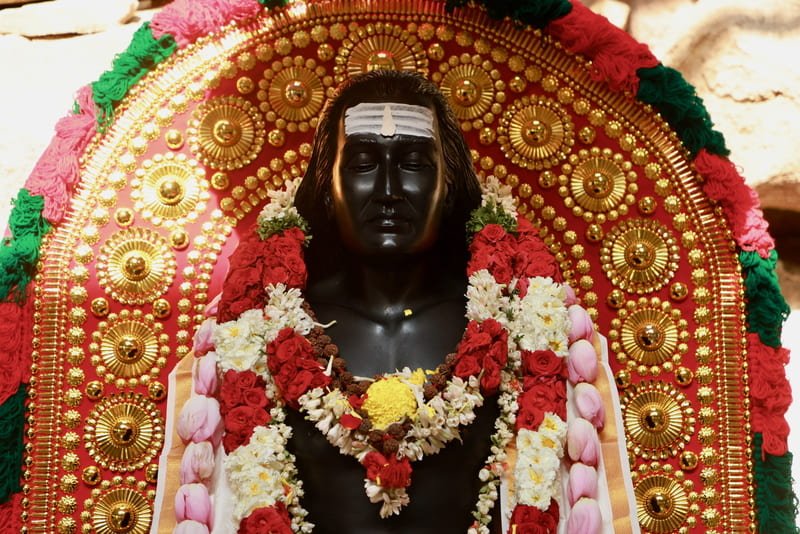
We consider Sri Guru as Adinath. We also consider him as Sadashiva.
So while there is a temple outside, he is also inside your heart at all times. When you meditate and chant Om Namah Shivaya, let your attention be on the Bhrumadhya or the Hridaya
Hridaya: The Centre of Compassion
One advantage also is that when your Shiva linga is manifested in your Hridaya, it is Hri – daya. It’s that Hreem beejakashara sitting inside and giving compassion, daya. It’s the centre of compassion.
The more you meditate here, the more your compassion grows. We may never match Shiva’s compassion, but at least we can cultivate a little—here and there.
Shivam as Consciousness and Bliss
This brings us to why, in the Nirvana Shataka, Adi Shankaracharya ends every verse with:
Chidananda Rupa Shivoham Shivoham.
Notice the word Rupa, form. What form is this? Earlier we spoke of Nataraja; here we speak of Chidambara, Chidambaram. The form of the Supreme Shivam is Chit and Ananda – consciousness and bliss.
Chit is consciousness beyond everything. And fortunately for us, it is also within us. Not only within us, it is everywhere. It is all-pervading.
The word Chit means that which is not a padartha, not a material object, but that which is conscious.
Mind, Brain, and Consciousness
We often confuse chit with the mind. When we hear Chitta Vritti Nirodha (which means how to remove the vrittis of the chitta), we assume chit means mind. But if we look closely, what we call the mind, which we misunderstand as chit, which is pure consciousness, is actually the brain.
Can there be thought without the brain? No. Thought is produced by the brain. If the brain becomes weak, say, through lack of food, thinking also weakens.
So the mind is really a cluster of thoughts. It is not chit, consciousness. It is powered by consciousness, but it is a product of the brain.
The brain is like a sophisticated computer. Consciousness is the power supply and silent witness. Without consciousness, even the brain cannot function. But the thoughts created by the brain are not consciousness, in its pure form.
Surrender to Consciousness
No matter how much the mind expands, thought is still a product of the brain. Therefore, it cannot touch chit, consciousness. It can be conscious, but it cannot touch the essence of consciousness.
This is the good news: consciousness can touch you. You cannot touch consciousness.
You can, at the most, touch an image created with thought about consciousness. Nothing beyond.
So what do we do? We surrender. We say, “This is all I can do. Now I surrender.”
Therefore, if that consciousness has to touch us and it’s everywhere, the mind has to become free of brain thought. It has to become still. Even if you say, “I am now free of all thought,” you are thinking. Who is saying, “I am free of thought”? Me. And who is me? A personality concocted by the brain.
So when we understand that what we call chida, or chidakasha, the Supreme, or Shivam, which also means auspiciousness and bliss, the meaning of the word Shivam is auspiciousness, total auspiciousness.
Shivam is that which is beyond our brain thought. Shivam is something beyond what we can concoct with our brain and with our mind.
When we realise this, you become quiet. In that quietness, since the mind is limited, it cannot touch the unlimited. And when it settles down, then there is Shivam.
Once somebody went to Maheshwarnath Babaji in Rishikesh and said, you must give me the experience of Shivam.
Babaji said, it is not in my hands.
Then he said, I firmly believe that it is in your hands.
Babaji said, why do you say that you have the licence to understand Shivam?
He said, because 16 years of my life I have chanted Namah Shivaya, the Panchakshara. It is constantly there in my mind, whatever I am doing, what more can I do to do this?
Babaji said, all the chantings that you have done for 16 years, when you sit down today to meditate, roll it all up in your mind into a ball and throw it into the Ganga, then you will know Shivam.
This guy said, this is impossible because it is always running in my mind.
Babaji said, that means the Chitta is always moving in your mind. If the Chitta doesn’t become silent, how do you expect to see Shivam?
He said, no, it is not possible and went off.
Six days later, we met him on the banks of the Ganga. He was sitting and laughing.
So, Babaji said, Haan, kaise ho? He said, pagal ho gaya hu. Babaji said, bahut achcha, yehi toh main soch raha tha. Tu jab pagal banega, tabhi samjhega. You become mad, then only you will understand!
So, when the mind settles down, then there is Shivam.
Ananda and Moksha
The nature of Shivam is pure consciousness, and that consciousness is also Ananda. The mind is constantly searching for it, because somewhere deep within, we know it exists. But the search is usually outward.
No external change can bring about that inner change. Understanding alone helps – that I need to go beyond this limitation. And that is Chit, and it is Ananda.
Anantamanandam Brahma, that Ananda which is endless, which one does not need to do anything to acquire, which is our true quality, which our reality, which is Shivam.
Hence, Shivoham, Shivoham.
This is the inner meaning of the Panchakshara: Om Namah Shivaya. To touch this truth is called Moksha. And when Moksha happens, the state is:
Chidananda Rupa Shivam Shivam.
The greatest gift of all – Inside the core of your being,within you sits the marvellous supreme being called Shivam.
-Sri M
